

Glossary of Dental Services
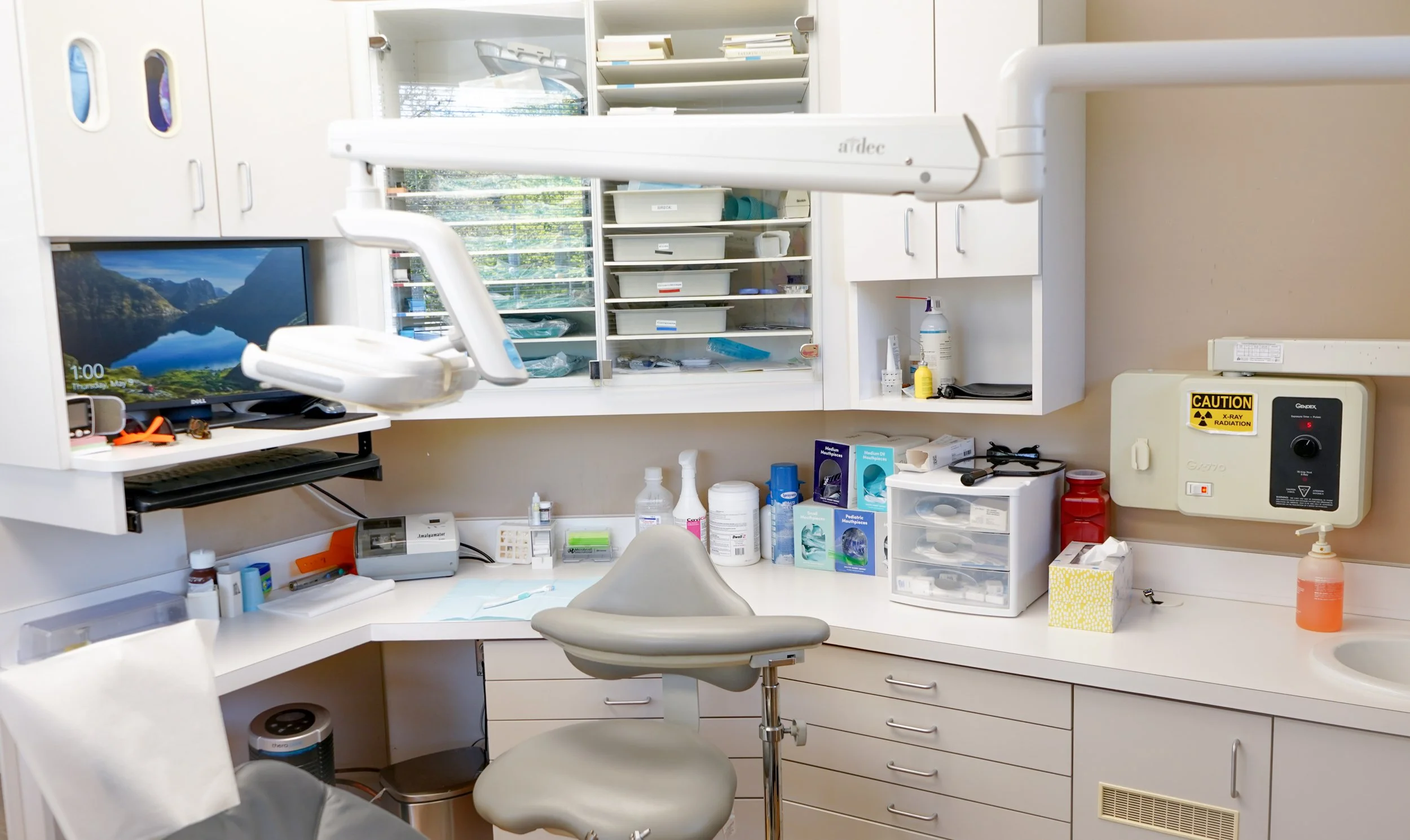
South Hill Family Dental offers a comprehensive dental care for adults and children of all ages. Below is a detailed description of the services offered.
Cleaning & Deep Cleaning
A dental cleaning or prophylaxis by definition involves the removal of plaque, calculus and stain that lies at or above the gum line. Plaque is the soft, white, sticky bacteria easily removed with your tooth brush and floss. Calculus on the other hand is the mineralized form of plaque that requires a professional to remove. A deeper cleaning (scaling and root planing) is usually needed when there is gum disease present. It is different from a regular dental cleaning because most of the cleaning is done below the gum line. The calculus and plaque are removed from underneath the gums and the roots are smoothed. This decreases the chances that bacteria will adhere to the roots and form calculus.
Protective Sealants
The back teeth, molars and sometimes pre-molars have deep grooves on the chewing surfaces. These grooves can be so deep and narrow that it can be impossible to clean down in the grooves. Bacteria, however, have no problem getting down to the full depths of these grooves and causing decay that can be hard to detect until it is quite advanced. Dental sealants now offer a means of successfully protecting molar and premolar chewing surfaces from decay. Recognized by the American Dental Association as a key means of cavity prevention, dental sealants are a thin resin film that can be applied to your at-risk tooth surfaces.
The same advanced bonding techniques used for cosmetic dentistry are used to bond the sealants in the grooves to seal out bacteria. The entire procedure is not only painless, but fast–requiring between ten and forty-five minutes, depending on the number of teeth we’re sealing. The cost of a sealant is much less than the cost of a filling, and it is an excellent investment to protect teeth from getting cavities at all. Over the years they can wear down, and should be checked regularly, which is another important reason for regular examinations and cleanings.
Regular Checkups
A healthy adult typically benefits from a professional cleaning and checkup every six months. While twice daily brushing and daily flossing go a long way towards maintaining a healthy mouth, it is wise to check for plaque that has hardened into calculus, requiring professional cleaning to avoid gum disease. In our office, we customize the interval at which a person requires cleanings depending on their current oral conditions.
Minimally Invasive Dentistry
Silver Diamine Fluoride as well as peptide treatments can help stop or reverse small cavities and do not require any numbing or drilling! Both are paint-on treatments and can be completed the same day as your regular cleaning or check-ups.
Night Guards
A night guard or bruxing splint covers the tops of the teeth in order to protect them from damage due to excessive night time grinding. They can also be made to help relax the facial muscles for those with soreness and pain around the Tempromandibular Joint (TMJ). Night guards come in a variety of designs and are custom made to your teeth. Dr. Craven will help find the appropriate appliance after an examination of the joints, muscles and teeth.
Mouth Guards
A mouth guard is a comfortable piece of athletic gear that fits over your teeth and can help protect your smile as well as your lips, tongue, face, and jaw. They should be used for a variety of sports activities. There are three types of mouth guards: ready-made, mouth-formed and custom. The ready-made and mouth-formed are less expensive and easy to buy. Unfortunately, they are not fitted exactly to your teeth, so they may seem bulky and uncomfortable in your mouth. Ready-made mouth guards can also only be held in place if your jaws are closed, which can make it difficult to talk or breathe during a practice or game. If you’re looking for the best fit, you can talk to Dr. Craven about custom-made mouth guards. Because they’re customized to fit your mouth, they’re more comfortable and less likely to interfere with speech or breathing.
Digital Imaging & Scanning
X-rays are an important tool used to identify decay and other abnormalities that can’t be seen by the human eye, even with magnification. Digital X-rays are similar to conventional X-rays but use much less radiation. They allow the image to be captured immediately onto a computer screen for viewing. The images easily enlarged for easier diagnosis. Dr. Craven follows the ALARA (as low as reasonably achievable) principle and personalizes the frequency X-rays must be taken. In many cases cumbersome impressions can be avoided by using a special camera to scan the mouth for crowns and other removable appliances.
Tooth-Colored Fillings
Tooth-colored fillings or composites are designed to match the color of your teeth. They are made of a mixture of glass or quartz filler and are designed to be used in small to mid-size fillings. Composites are glued into the filling or “bonded.” This allows less tooth structure to be removed when placing the filling as opposed to a silver (amalgam) filling which relies on the undercuts placed into the tooth to hold them. Composites tend to take longer to place because the tooth must be kept clean and dry while the filling is placed.
“Bonding” can also mean the placement of composite fillings on the front teeth to close spaces or correct rotations.
Crowns & Bridges
Crowns
Crowns are used to cover the tooth when there is extensive damage done to the tooth from a broken cusp, filling that is very large or cracks. They are also placed over dental implants and teeth that have had root-canals. Crowns protect the tooth from breaking and mask teeth that are poorly shaped or discolored. They restore the teeth to their normal shape and size.
Bridges
If you are missing a tooth, a permanent bridge can often be made to replace it. It should look and feel natural, without hooks or clasps, and stay in permanently, allowing totally normal function. When teeth are missing, the remaining teeth begin to change position. This can lead to numerous problems, including loss of more teeth. A fixed bridge will prevent teeth from shifting, and stabilize your bite. They can also be attached to implants. Bridges can help restore your smile.
Veneers
Many people desire a brighter, cleaner and more attractive smile but have chipped, stained, discolored, unevenly spaced, or even slightly crooked front teeth. If this sounds like you, we will gladly evaluate your unique situation and listen to the changes you have in mind. Porcelain veneers can offer a minimally invasive way to provide a dazzling smile in just a few appointments.
A veneer differs from a crown because much less tooth is removed when compared to a crown. An impression of your teeth is taken and then sent to the lab where a technician makes the veneers out of porcelain. The veneers typically provide superior esthetics compared with direct placed composites or “bonding.” We show you examples of the end result before any treatment is performed.
Whitening
South Hill family dental offers both in-office and take-home whitening procedures.
Is it safe?
Yes, whitening your teeth, under the supervision of your dentist, has been proven safe in clinical studies over a period of many years. The primary ingredient in our bleach is carbamide peroxide, which has been safely used to brighten the smiles of millions of people worldwide.
How does it work?
Whitening gel is placed in thin comfortable trays and fitted over your teeth. As you whiten your teeth, carbamide or hydrogen peroxide is broken down and oxygen enters the enamel and dentin. This bleaches out the discolored areas. The structure of the tooth is not changed. The color of the tooth is simply made lighter. The trays are either pre-fabricated or can easily be made by scanning or taking impressions of your teeth. In-office whitening involves a couple hours of your time, and a higher power get is painted directly onto the teeth and supervised by the dentist.
How long does it take?
Optimum natural whiteness usually occurs when the process is continued for a week to 10 days. Dr. Craven will go over what you can expect for your individual situation.
Are there any side effects?
It is possible to experience increased sensitivity to hot or cold during the whitening process. This is temporary and usually prevented by carefully following the instructions provided by Dr. Craven and her staff. The sensitivity will normally go away within the first 48 hours after the whitening process is completed.
How long will it last?
The duration of your results depends largely upon you. Practice good oral hygiene and brush normally, especially after consuming staining foods or beverages and your results could last for years. If you use staining substances like coffee, tobacco, and red wine, you may want periodic touch-ups.
Root Canals
Root canal treatment usually involves the removal of the tooth pulp, a small thread-like tissue inside the tooth that contains blood vessels, nerves and connective tissue. Once removed, it is replaced with materials that seal off the root canal from its surrounding tissues. Years ago, diseased or injured teeth were often extracted. Today, even if the pulp in one of your teeth becomes injured or infected, the tooth often can be saved through root canal (endodontic) treatment.
Why does the pulp need to be removed?
If the injured or diseased pulp is not removed, the tissues surrounding the root of the tooth can become infected and an abscess can form, resulting in a pain and swelling. Even if there is no pain, certain substances released by bacteria can damage the bone that anchors the tooth in the jaw. Without treatment, the tooth may have to be removed.
Why couldn’t you just remove the tooth?
There are many disadvantages to losing a natural tooth. When a tooth is removed and not replaced, the adjacent teeth may begin to shift from their natural position. This may cause the teeth to become crooked and crowded, which decreases biting and chewing efficiency. Crowded or crooked teeth may be more prone to gum disease because they are harder to keep clean than properly aligned teeth. A replacement tooth (an implant or bridge) is usually more expensive than endodontic treatment and can involve more extensive dental procedures on adjacent teeth. A natural tooth is normally better than an artificial tooth.
Dental Implant Restoration
If you are looking for an option to replace one or several teeth, a dental implant may be the best choice for you. The main benefit of implants is they replace tooth roots so individual crowns or even dentures may be attached to them.
An implant is a special surgical grade titanium post, manufactured to highly precise specifications, under strict sterile conditions, that is inserted surgically into the jawbone below the gum surface. As the bone bonds to the post, it forms a secure foundation onto which your new teeth are then attached and shaped to match your mouth.
Dentures & Partials
Dentures and partials are removable appliances that replace missing teeth. They will make it easier for you to eat and speak as well as support your facial muscles. If the facial muscles are not well supported, they can sag and make us look older. Dr. Craven will take the time to make sure these appliances fit well in your mouth and help you look your best.
Snore-guards & Sleep Apnea
Have you been told that you snore? It could be affecting either the quality of your sleep or those around you. Some people who snore also suffer from sleep apnea which is when your regular breathing is interrupted during sleep. If left untreated, it can result in other medical problems such as high blood pressure, stroke, heart failure, heart attack, diabetes or depression. Sleep Apnea is often treated with CPAP (continuous positive air pressure), or in mild cases, an oral appliance. Dr. Craven can make you a snore guard to help with these conditions and your partner will thank her for it!
Botox
Used for treatment of TMD and headaches as well as cosmetic purposes.